Fifteen years building organic lead engines end to end — content architecture, rankings, CRM, routing, the dashboard the operator opens every morning. Three properties in the niches Google polices hardest. Built by one person. No ad spend, no team, no budget, on any of them.
Semrush ranks organic competitors by shared keyword footprint. On veteransunited.com, the first name on that list is a site I built by myself with no budget and no team.
6,702 keywords in common — enough that Semrush ranks VA Loan Network as the #1 organic competitor to a company that originated $19.29 billion in VA loans last year, employs 3,314 people, and buys 204,500 visits a month on top of a 685,000-backlink profile. Two years. No ad spend. One person.
Every number below is verifiable in Semrush or Search Console. I show the decline as readily as the climbs, because anyone who only shows you the climbs hasn't been in this long enough.
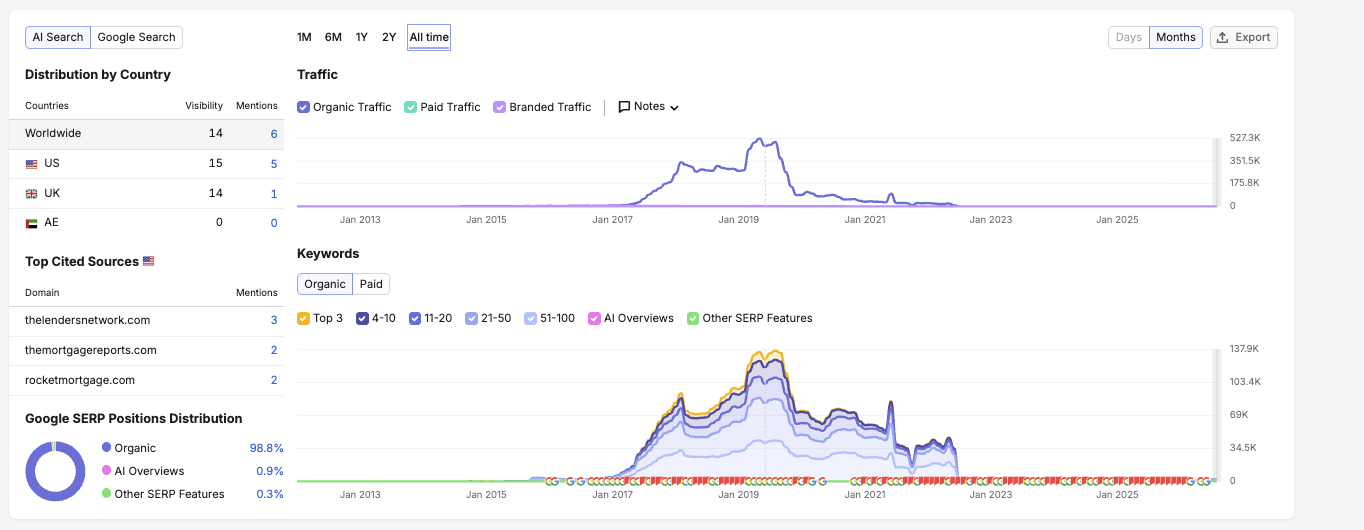
Zero to 527,281 monthly organic visitors and 15,000 leads a month, solo, with no marketing spend and no team. At peak it held 135,349 ranking keywords and six-figure lead contracts with Quicken, Carrington and NAF.
Then Google's Your Money or Your Life update landed and took most of it inside a year. I learned what Google wants from financial content the expensive way — and everything since has EEAT in the architecture from the first page, not bolted on after.
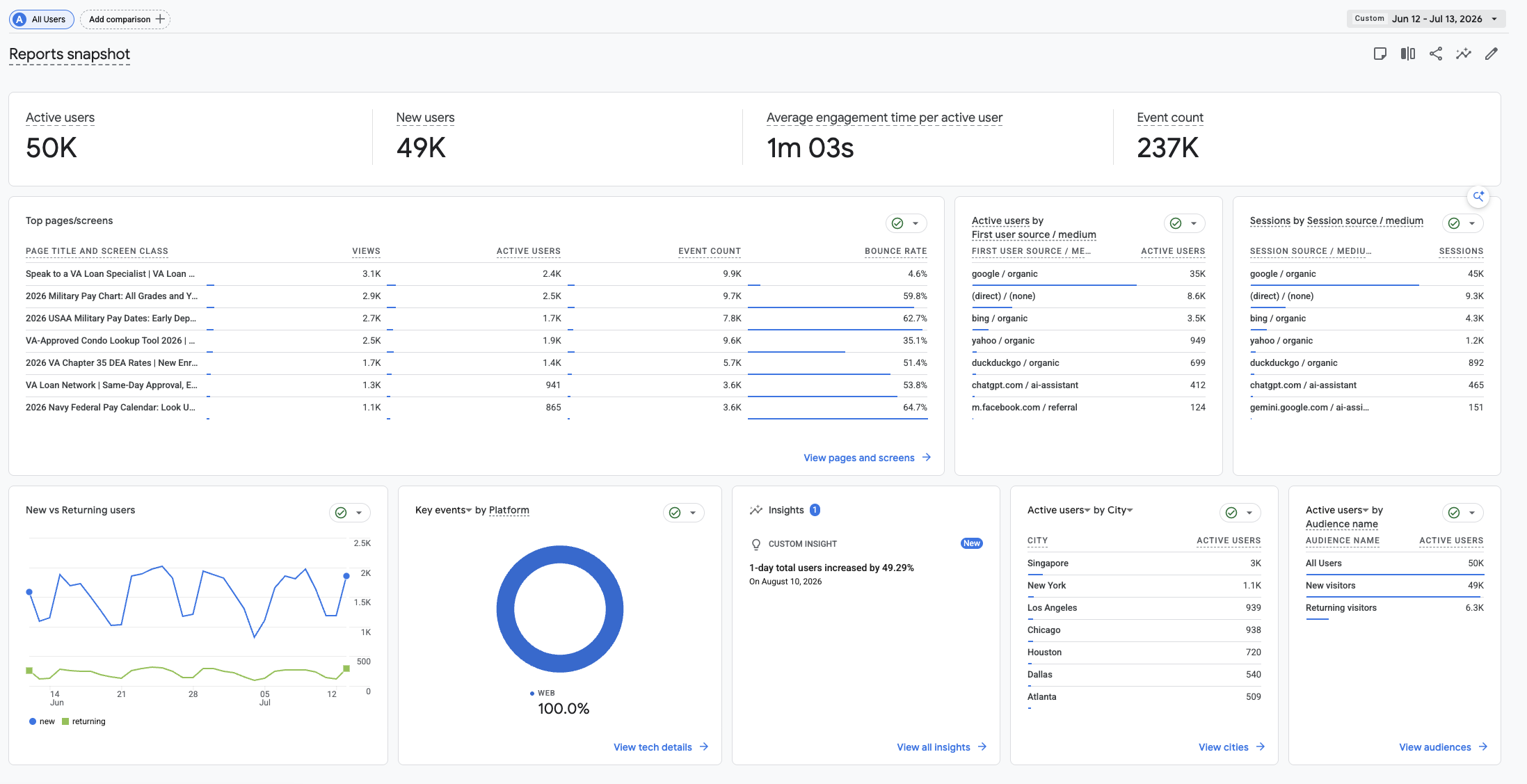
From nothing in two years to 50,338 monthly visitors and 37,100 ranking keywords — 4.1 million impressions in the last 28 days at an average position of 8.3. Over 80% of tracked keywords sit on page one, and ChatGPT and Gemini now send traffic directly.
The site is only half of it. I built the CRM integration, lead routing, drip system, commission audit and operator dashboard — 4,809 leads in the database and a live command center that runs the business.
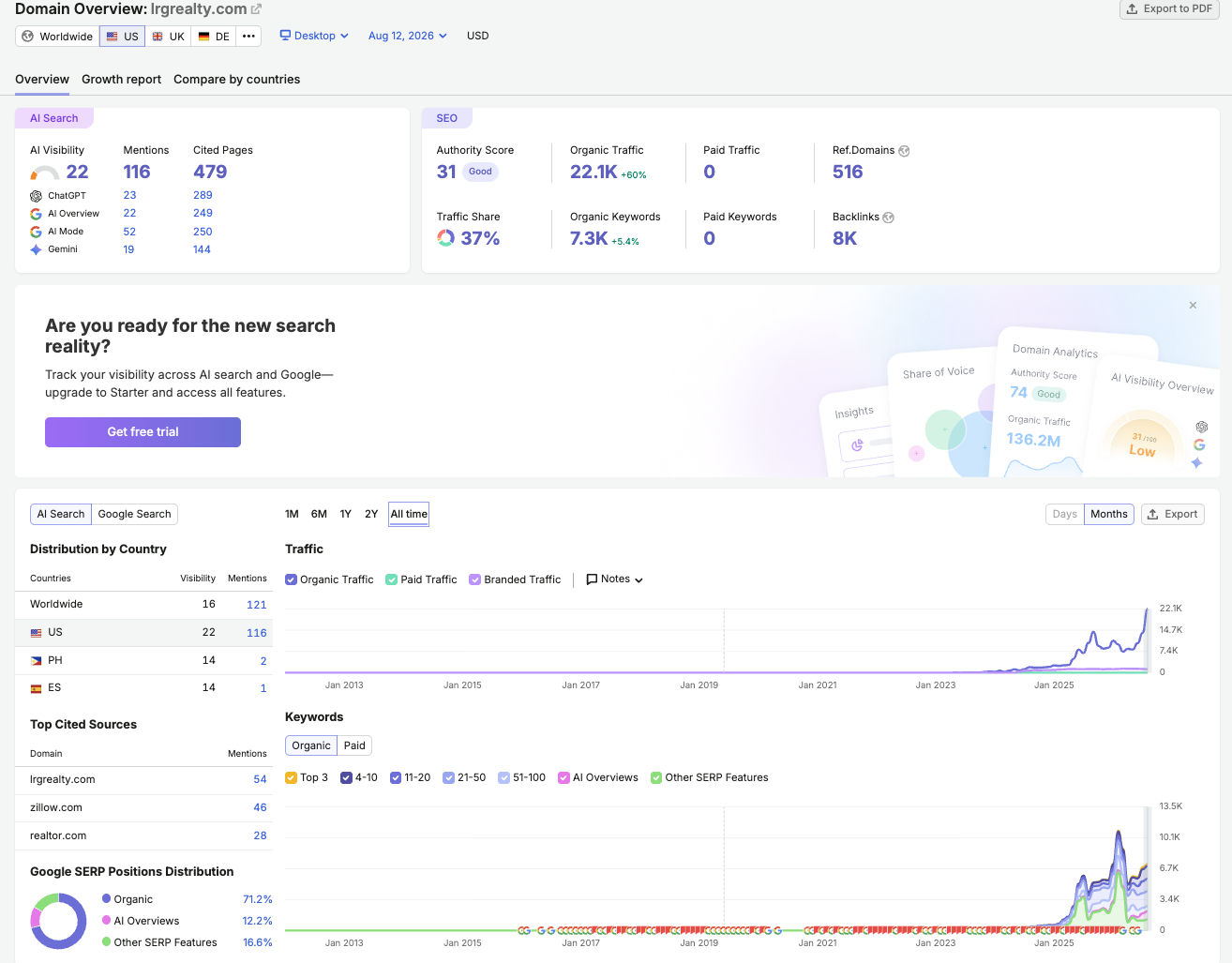
A local brokerage site that was effectively invisible to Google in August 2024. Twenty-four months later it runs 22,070 monthly organic visitors on 7,259 ranking keywords, up 60% and still climbing — outranking Zillow and Realtor.com on its own market's terms.
Done part-time, on someone else's business, using the same content system. Which is the point: the architecture isn't specific to one site. It replicates on any local real estate market in the country.
Six layers, all of it built by hand. Most people in search do one of these. The engine only works when the same person builds all six.
Topic clusters mapped to real search demand and real buyer intent, internally linked at a scale that only works when it is systematic rather than manual.
Licensed reviewers, author entities, citation structure and schema built in from page one. In mortgage and finance this is the difference between ranking and being erased.
An RSS and content system that keeps a site publishing at volume without a content team, and without the thin-page penalty that usually comes with volume.
Forms and flows built for the actual loan or listing conversation, so what reaches the CRM is a qualified borrower rather than an email address.
Webhook integration, lead distribution, agent assignment, drip sequences and referral agreements that fire on their own, into whatever stack is already in place.
Live rankings, lead flow, pipeline, close rates and commission audit in one screen. Traffic without measurement is a vanity metric — this is where the money leaks.
Reached fastest by email. Headshot and long-form bio available on request.
Randall Yates is the founder and publisher of The Lenders Network and a builder of organic lead engines in mortgage and real estate. Fifteen years in YMYL search, he has taken three properties from zero — one to more than half a million monthly visitors and 15,000 leads a month — working solo, without paid acquisition.
He has negotiated lead contracts with national lenders including Quicken, Carrington and NAF, and works in the parts of search most commentary never reaches: what happens after the click, whether the lead gets called, and whether traffic ever turns into revenue.
He can speak to how Google's YMYL and EEAT standards reshaped financial publishing, what AI Overviews are doing to mortgage search traffic, and why most lead-generation businesses fail at follow-up rather than acquisition.